 By
By Despite the work of local historians and community advocates who have documented the city’s Black histories, London’s relationship with Blackness has been complicated.
Western University, the city’s largest postsecondary institution, has its own layered history in this regard. It is not widely known for a longstanding institutional commitment to Black Studies. Yet today, somewhat unexpectedly, it is among the first universities in Canada to offer a Black Studies major.
I work at Western, but this is not a promotional piece. It is an invitation to think more critically about what Black Studies might offer, both inside universities and beyond them.
For the past few years, I have taught “Introduction to Black/African Diaspora” at Western. Part of that course unfolds beyond the classroom through a partnership with Yaya’s Kitchen, a locally owned Black culinary space in London.
Students are often surprised that such a place exists. That surprise is telling. Early in the term, they examine how Black life in Canada has been framed as marginal through works such as Katherine McKittrick’s Demonic Grounds, Afua Cooper’s The Hanging of Angélique, and Rinaldo Walcott’s Black Like Who? These texts unsettle the myth that Black presence here is recent or peripheral. That a Black culinary space in London feels remarkable reveals how persistent that myth remains.
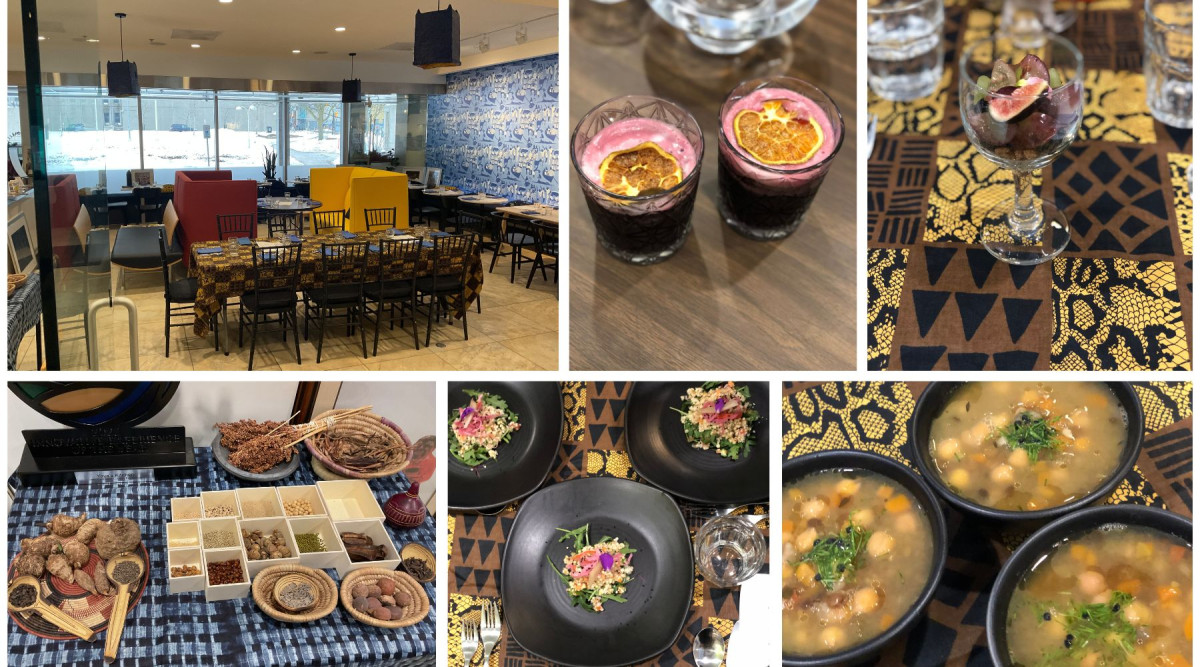
Yaya’s Kitchen is remarkable for the stories embedded in its menus. The supper club reshapes its tasting menu to bring together culinary traditions that span geographies. Pairings such as Nigerian and Trinidadian dishes, or Jamaican and Sudanese flavours, unsettle any easy notion of a singular “Black cuisine.” As co-owner Malvin Wright explains, those expecting familiar staples such as jerk chicken or jollof rice will not find them here. The menu insists on something more expansive.
For my course, Yaya’s Kitchen becomes a site for thinking about migration, trade, adaptation, and ritual. By the time we arrive, students have studied European expansion and the Columbian Exchange, the forced movement of people and crops, and the plantation systems that reshaped global diets. Ingredients such as rice, okra, and plantain trace routes of empire and commerce. They reveal how Black diasporic foodways were shaped under constraint, and how creativity endured.
A conversation about food is necessarily a conversation about labour. Contemporary food systems remain structured by inequality. In Canada, seasonal agricultural workers continue to labour under exploitative conditions. To ask what we eat is to ask who plants, harvests, and prepares it. A meal is produced by social and economic relations that stretch across borders.
We are called to the table and invited to wash our hands before eating. We are encouraged to eat with them. These gestures situate the meal within embodied traditions of hospitality. Malvin Wright guides us through an index of flavours and their histories. The restaurant bears the namesake of Maryam Wright. “Yaya,” meaning eldest sibling, signals an ethic of care that shapes the space.
Students respond differently. Some recognize ingredients prepared in ways that echo their own households. Others reflect on similarities and differences in how food is cooked and shared in their families. Occasionally, a student’s face lights up in recognition.
Rinaldo Walcott, in “On Inheritance,” suggests that inheritance is an ongoing practice rather than a static bequest. At Yaya’s Kitchen, students encounter inheritance materially. Recipes carry memory. Techniques encode relationships to land and climate. Food becomes an archive of movement and survival.
Cooking and eating here also raise questions of place. As Tamunoibifiri Fombo argues, building life in Canada requires confronting the ongoing realities of settler colonialism. To cultivate diasporic traditions is to do so on land marked by dispossession. Food connects us to land shaped by histories of removal and violence. How do communities sustain memory within those conditions? How do culinary practices express continuity without erasing the histories that make such continuity fraught?
Sharing a meal within Black diasporic traditions has long been a practice of community-making. Kitchens and tables are spaces of planning, dreaming, and political imagination.
For students, encountering theory through taste, touch, sound, and sight shifts the scale of learning. Migration becomes embodied in flavour, in the music that fills the room, and in the artwork that frames the walls. Globalization becomes intimate. Labour becomes visible. Knowledge exceeds the page.
This feels especially urgent in the current climate of higher education. Universities are increasingly pressured to operate according to logics of efficiency and measurable output. Courses are streamlined. Learning is packaged. Ontario Premier Doug Ford recently dismissed certain fields as “basket-weaving courses,” shorthand for pursuits presumed to lack economic value.
A dinner like this could easily be folded into that caricature. A course dinner might appear wasteful. But to treat it as such is to misunderstand what is at stake.
A gathering at Yaya’s Kitchen opens conversations about Black entrepreneurship and the structural barriers business owners encounter. It raises questions about urban planning and the kinds of spaces prioritized in city development. It prompts discussion about sourcing ingredients and the entanglements of international trade and foreign policy that shape what arrives in Canadian kitchens. It leads to conversations about agricultural labour, immigration policy, and the conditions under which food is produced. Food is never only cultural expression. It is political economy.
It is also about the right to eat and to gather with dignity. The United Nations defines the right to food as access to “quantitatively and qualitatively adequate and sufficient food corresponding to the cultural traditions of the people to which the consumer belongs, and which ensure a physical and mental, individual and collective, fulfilling and dignified life free of fear.” To take food seriously in a classroom is to take that right seriously.
Against the reduction of education to narrow metrics of utility, a shared meal slows the pace and makes space for unhurried conversation. It demonstrates that what may be dismissed as peripheral is deeply entangled with economics, governance, and human rights.
It is also deeply satisfying as an instructor. There is power in watching students recognize their own histories and cultural practices as worthy of sustained academic inquiry. The ivory tower feels less distant. The boundary between lived experience and intellectual life grows more porous.
If Black Studies, as institutionalized in Canadian universities, is to be worthy of its name, it must remain accountable to lived experience. It cannot reside only in lecture halls. It must engage the spaces where Black life is sustained and remade. Treating the city as a classroom and a restaurant as a site of pedagogy is one attempt to enact that commitment.
A meal at Yaya’s Kitchen will not resolve structural inequities. It can, however, create moments of recognition. Seated at a table, sharing stories of family and migration, learning becomes something we experience together. It is a reminder that learning can be both rigorous and pleasurable.