 By
By Tika Simone left Toronto because she couldn’t afford to stay.
A Canadian Academy Award-winning composer. A woman who put Daniel Caesar on his first stage at 16. Who built Known Unknown, one of the city’s most important music showcases from nothing. Who helped make Toronto’s underground culture possible for nearly a decade. In 2018, she packed up and moved to Montreal. Not because opportunity called her there. Because Toronto’s unaffordable rent pushed her out.
“Stable housing isn’t just an address,” Simone says now, from Montreal, where she’s studying art innovation at the Global Leaders Institute. “It’s the ability to exhale. It’s the difference between making work to survive and making work to last.”
She’s not the only one who left. She’s not even close.
Across the GTA, Black creatives are leaving, and when they go, they don’t just take their canvases, beats, and scripts with them. They take the informal mentorship networks, late-night studio critiques, and kitchen table collaborations that turn neighbourhoods into scenes and scenes into movements.
While the Black population in the Greater Toronto Area (GTA) has grown in total numbers over the last 30 years, data indicate that the Black population in the City of Toronto specifically has begun to shrink, with significant displacement and migration to suburban regions (like Ajax and Brampton) driven by high costs and gentrification.
Behind each quiet departure is a housing market that has made it nearly impossible to sustain a creative life here: Black residents account for 15.8 percent of those in core housing need while making up just 9.6 percent of the city’s population, and Black renters disproportionately face overcrowding or eviction.
The average one-bedroom in the city now rents for $2,295 a month. To meet the under-30-per-cent-affordability rule, a renter would need to earn roughly $86,000 annually.
Joseph Bonsu knows this math intimately. A graphic artist and illustrator now living at Mirvish Village—the pilot project being replicated at Cherry House—he spent years freelancing from his parents’ basement in Mississauga, building his brand, Heroes of the World, while the prospect of living independently grew increasingly out of reach.
“I found a place around Eglinton and Bathurst,” he recalls. “I was about to sign. That same day, my part-time job cut my hours. I had to forfeit the place.”
He’d checked PadMapper every day. $2,000. $2,500. $3,000 for a one-bedroom. His family told him it wasn’t realistic. “There was a lot of pushback,” he says. “But I thought, forget it. I know I can do this. There must be a better way.”
Traditional “affordable housing” models assume steady paycheques and linear careers. But creative work rarely looks like that. Income spikes around releases and dries up between projects. A grant might cover gear but not a rehearsal space; a viral moment doesn’t guarantee next month’s rent. In a city where you now have to earn more than 40 dollars an hour for a one‑bedroom apartment, space isn’t a luxury for Black creatives; it’s the raw material of the work itself.
Standard income verification demands proof of steady employment. For a freelance illustrator who might earn $5,000 from a commission one month and nothing the next, the system sees instability where there is, in reality, a career. “Those bigger gigs are very few, and they’re far and few in between,” Bonsu says. “I could get a gig that pays thousands of dollars. But I could not see that again in six months.”
But income is only part of what traditional models miss. They miss the infrastructure artists need: studio space, soundproofing, proximity to collaborators, and the kind of community that turns a building into an ecosystem. Conventional affordable housing treats residents as individuals in need of shelter. Artist housing, done right, treats them as nodes in a network.
Rookz—Kiana Eastmond, music executive turned real estate entrepreneur—puts it bluntly. “Condo developers are single-handedly one of the worst things for any real estate market. They drive up the cost of square feet in major cities.” She watched it happen firsthand: when she tried to find a space for Sandbox Studios, one landlord rejected her on sight. “He literally looked at me and said no,” she recalls. “And the irony is that he was the son of the man who was my mom’s landlord for fifteen years.”
The system doesn’t just exclude Black artists economically. It excludes them structurally, through bias, through bureaucracy, through models that were never designed with their lives in mind.
Housing as cultural infrastructure
So, what does a model designed with their lives in mind look like?
Blackhurst Cultural Centre, formerly A Different Booklist, one of Toronto’s most beloved Black-owned bookstores, has spent years building the answer. And their approach is deceptively simple: treat housing not as charity, but as cultural infrastructure.
The distinction matters. Charity says, “We will house you because you are in need.” Cultural infrastructure says, “We will house you because you are essential.” The first model makes artists dependent. The second makes them sustainable.
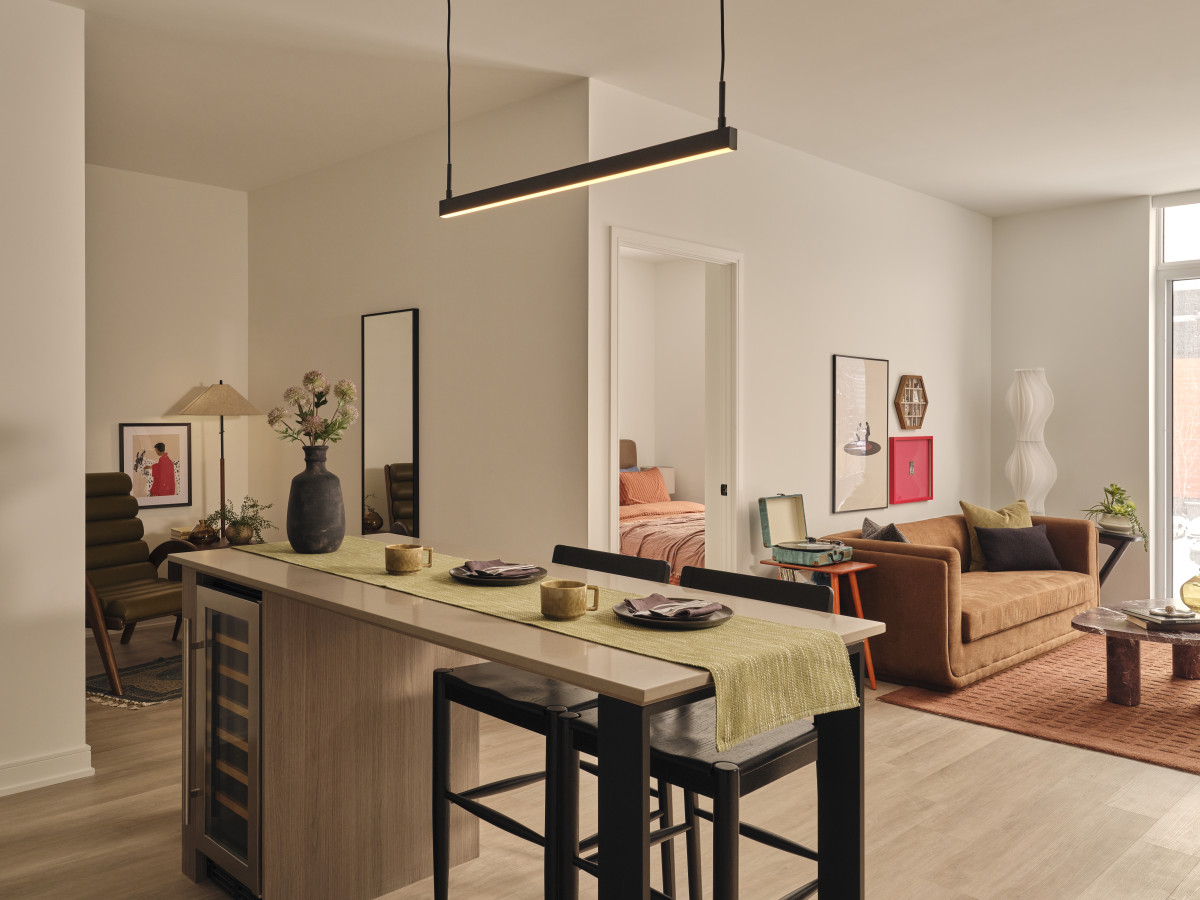
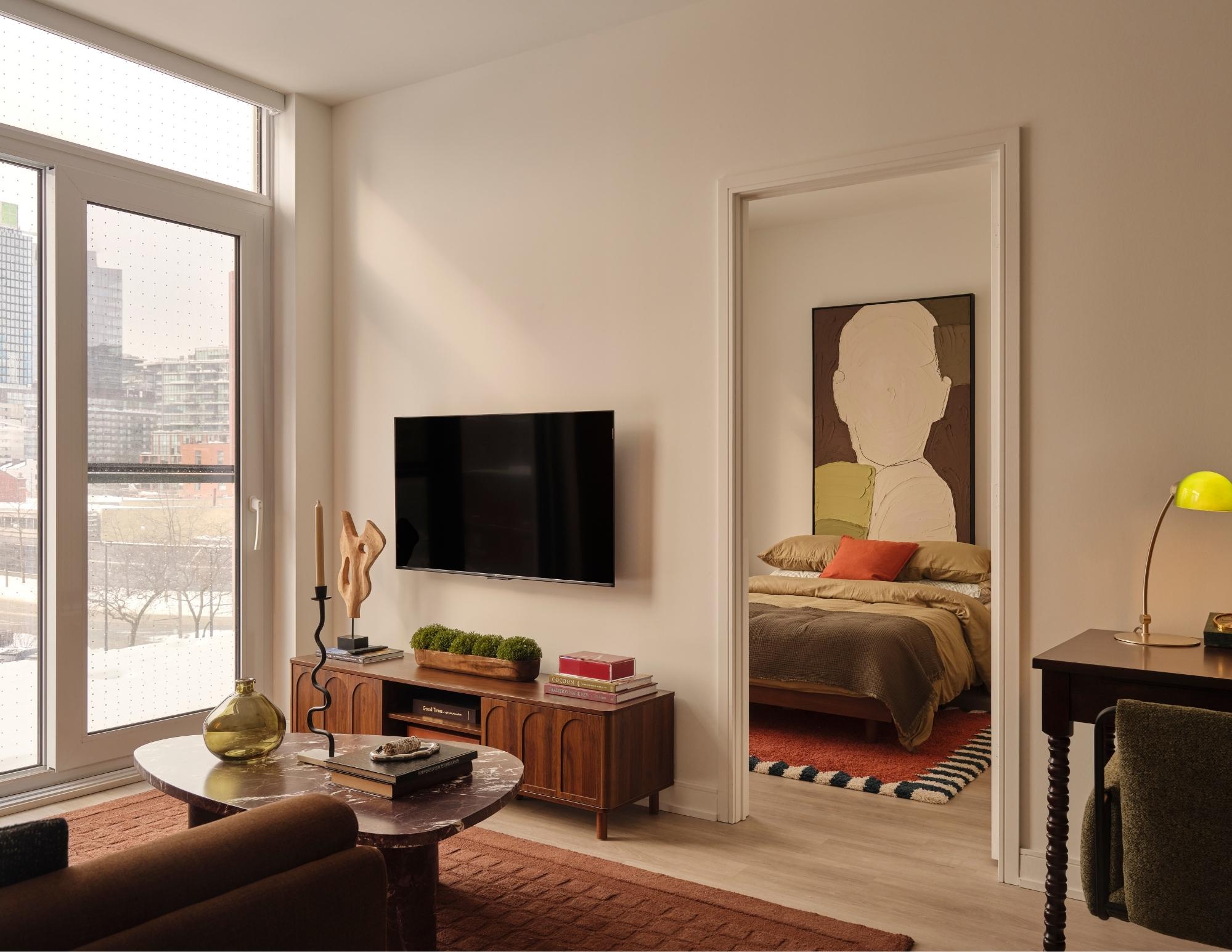
Cherry House at Canary Landing is the newest iteration of that idea. Twelve long-term, rent-controlled one- and two-bedroom units—priced at 40 to 80 per cent of market rent—have been secured specifically for Black artists, cultural workers, and community builders through a partnership between Blackhurst Cultural Centre, Tricon, and WoodGreen Community Services.
 Cherry House Unit Photo Courtesy Tricon
For Tricon, the partnership is part of a much larger development strategy. Cherry House is an 855-unit purpose-built rental building, with 30 per cent of homes—257 units—designated as affordable housing. Of those, 245 are allocated through partnerships with organizations including WoodGreen, Wigwamen, March of Dimes, and Performing Arts Lodge, serving Indigenous households, performing artists, people with disabilities, and other communities facing housing barriers. Tricon says it plans to advance similar models in future developments, including The Stella and the redevelopment of the Toronto Coach Terminal.
“Toronto’s creative community is one of the city’s defining strengths,” a Tricon spokesperson said. “If people are contributing to that culture, they should be able to afford to live here.”
And the difference shows up in the design. The 12 Blackhurst-brokered units are scattered throughout the building, indistinguishable from market-rate apartments. No separate entrances. No visual markers. No poor door. Residents have access to the same amenities as everyone else: an art room, music studio, gym, courtyard, meeting rooms, and bookable event spaces.
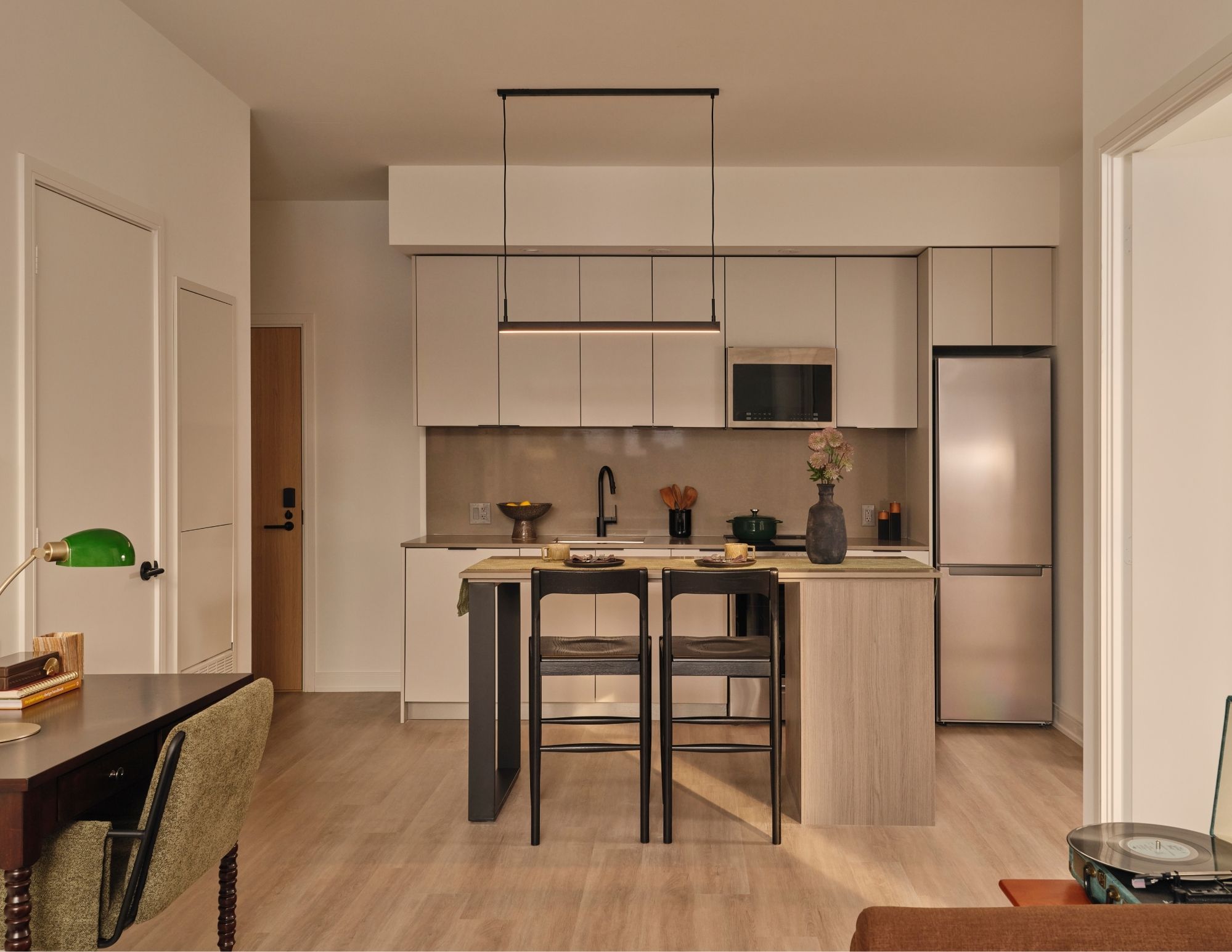 Cherry House Unit Photo Courtesy Tricon
“In other models, the affordable units are visibly separate,” says Sonelle Crawford, an urban planning graduate and administrator at Blackhurst. “Here, they’re spread throughout the complex, so no one would know.”
Eligibility for the Blackhurst units is intentionally broad. Not only working artists, but also emerging ones. Not only creators, but also the facilitators, educators, and cultural workers who keep scenes alive. “You can’t really box artists,” Crawford notes. “And the people supporting artists are just as critical.”
Applicants must submit a resume, portfolio, and a statement of up to 500 words answering why this matters to them and how they plan to contribute. The selection committee includes cultural creatives who understand artistic practice. Not bureaucrats checking boxes.
Simone sees the logic. “Programs like Cherry House are powerful because they treat housing as cultural infrastructure rather than a perk,” she says. “When you have steadiness, you can create with depth, instead of operating from survival mode.” But she’s also not finished asking the harder question: “Twelve apartments are a start, but they’re not the solution. I’ve mentored hundreds of marginalized Black youth—artists who lit the spark of Toronto’s sound and style. But where are they supposed to go now? Twelve units exist. Hundreds still don’t have space, visibility, or viable support.”
The proof already exists
After Honest Ed’s was demolished and Blackhurst itself faced displacement, its co-founder, Itah Sadu, negotiated with city councillors and developers for permanent space. That advocacy secured a 49-year lease and the first artist housing partnership at Mirvish Village on the former Honest Ed’s site.
It’s there that Bonsu now lives. He applied for the program and waited roughly twelve months before he got the call.
“Emotionally, it was an accomplishment,” he says. “I’d been trying to move downtown for a while. It was either that the prices were too high, or nothing was available. Plus, there’s the whole renting while Black thing. That’s an ultimate barrier.”
The change has been tangible. Bonsu can now focus on Heroes of the World, the brand he co-founded with his friend Mark Williams in 2005, which started as art prints at Caribana and has grown into a comic book series, merchandise line, and school workshop program. “I can concentrate enough to finally hone in,” he says. “Finish projects. Work on new pieces. Without interruptions.”
Affordable rent has also let him reinvest. “It’s helped me upgrade equipment,” he says. “It’s helped me keep track of my budgeting. I know what comes out every month. So, everything else goes towards the work.”
He’s not a temporary resident looking for an exit. “I’ve never seen affordable housing as a temporary fix,” Bonsu says. “Something like this should be permanent. It’s not a temporary thing. It shouldn’t be.”
The model at Mirvish Village works because proximity creates possibility. Artists live across the street from Blackhurst, creating a self-reinforcing ecosystem. “If we need to employ someone for a project, they’ll either do it, or they’ll know someone who can,” Crawford says. Housing stability becomes professional infrastructure. Security creates the conditions for risk.
Bigger than twelve
Cherry House is the next step. But both Simone and Rookz want to push further.
Simone’s vision is systemic. She’s currently pursuing an MBA in arts innovation at the Global Leaders Institute, building what she calls Iverna Island—a framework for designing ecosystems where artists have safety, care, and longevity, not just visibility. It’s built on the principle that creativity thrives where care is built in. She points to models like Sweden’s Emerge Lakefront, a developmental community built around artists with its own performance hall, apartments, and shared spaces.
“Why are we thinking so micro when it’s macro?” she asks. “Artists shape how the world sees this city. Our music, murals, and festivals draw visitors, fuel tourism, and define Toronto’s identity. We build the stories that others profit from. So why aren’t we being appropriately compensated for that labour?”
Rookz is sharper still. She isn’t opposed to Cherry House—but she’s clear-eyed about the gap between survival and power. Even with 30 per cent of Cherry House designated as affordable housing, she argues that true equity requires thinking beyond rental access alone. “Twelve units for Black creatives is meaningful,” she says. “But we have to ask bigger questions about ownership and long-term wealth.”
Rookz wants to see the next evolution: rent-to-own pathways, financial-literacy pipelines, and discounted purchase options for residents who have demonstrated stability. “That’s how you really show up,” she says. “It’s not about giving you a unit. It’s about how you are able to, every single day, show up and make money for yourself.”
Crawford acknowledges the tension. Blackhurst’s goal, she says, is replication—hoping other nonprofits with deep community trust will adopt the broker model and partner with developers to secure housing for their own cultural communities. “Cities and housing are more than physical space,” Crawford reflects. “It’s the people that fill these spaces, and how they interact with them.”