 By
By Dresden’s claim to fame was that it was a key stop on the Underground Railroad and also home to Josiah Henson, a former U.S. slave whose story inspired the classic novel Uncle Tom’s Cabin.
But Hugh Burnett, an African Canadian, Second World War veteran, carpenter, and father, was about to learn what racism looked like when it took off its polite mask.
After being refused service, Burnett wrote to the federal Justice Minister Louis St. Laurent, certain this had to be illegal. The reply shocked him: racial discrimination was perfectly legal in Canada. Property owners could refuse service to anyone they wanted. It was called "freedom of commerce."
Meanwhile, Canadians were reading news from the United States with sympathy, shaking their heads at American racism. The irony wasn't lost on Burnett. In Dresden, the same town that had been a beacon of hope during the Underground Railroad, where thousands of formerly enslaved African Americans found refuge, the descendants of those freedom seekers couldn't get a haircut or a meal.
"Burnett's activism was radical and useful because he made Canadians face the hypocrisy of life for Blacks in Canada," explains Christopher Dummitt, a Canadian history professor at Trent University. "The difference between what was polite to believe in Canada, that discrimination was un-Canadian, and the reality of actual discrimination was suffered by many people like himself."
The vote that said the quiet part out loud
In 1948, Burnett joined his three uncles—William, Percy, and Bernard Carter—to form the National Unity Association (NUA), a pivotal civil rights organization that fought anti-Black racism in Southwestern Ontario. Their first move was strategic: they circulated a petition asking business owners and politicians whether they supported racial discrimination.
Of the 118 people presented with the petition, 115 signed that they were opposed to discrimination.
Armed with this evidence, the NUA asked Dresden Town Council to pass a bylaw to make discrimination illegal. The mayor, who had signed the anti-discrimination petition, pushed back. "If this was a socialistic state, and the restaurants were owned by the state, we would have control, but how can you force any man to serve anyone he does not want to serve?"
A councillor suggested democracy required a referendum. Let the people decide.
The NUA returned to the council six more times over the following months, trying to stop the vote. The provincial press picked up the story: an Ontario town was putting racial equality to a popular vote. Resentful white residents blamed the NUA for the bad publicity. Death threats arrived in Burnett's mail.
On December 5, 1949, Dresden held a referendum on a simple question: should Black people be allowed to eat in restaurants? The vote wasn't close.
517 residents said no. 108 said yes.
The demographics told the story: 83% white, 83% against equality.
The legal innovator
Most activists would have given up. Burnett went bigger.
The referendum's brutal publicity had an unintended consequence: it gave the NUA a coalition. Toronto reformers who had been lobbying Premier Leslie Frost for fair practices legislation needed proof that Canadian racism wasn't just an American import. Dresden gave them that proof in data.
In January 1950, Burnett and the NUA joined a delegation to Queen's Park. The Premier declined to act, insisting education was the proper cure for racial bias. But the campaign worked. In February 1951, Ontario passed the Fair Employment Practices Act, outlawing discrimination in hiring.
Burnett wrote to the Premier immediately: "We beg of you Mr. Premiere [sic] to include in your fair practise bill a clause covering public service."
This went beyond lobbying. Burnett was drafting legislation for a right that didn't exist anywhere in North America. Several American states had fair employment laws by then, but none covered public accommodations, restaurants, barbershops, or hotels. Burnett was pushing for something unprecedented.
The Premier ignored the letter. So, Burnett went to Ottawa in May 1951, meeting with Prime Minister Louis St. Laurent, the same man who, as Justice Minister, had told him discrimination was legal. They promised support "when the time was right."
Burnett made the time right. The NUA kept discrimination in the news through Brotherhood Week events, letters to editors, and speakers at annual meetings. When NUA member Alvin Ladd was refused service at a Chatham hotel in May 1953, they launched a complaint with the Liquor Licensing Board. The hearing in December 1953 brought Dresden back into the headlines.
In March 1954, a massive delegation of labour, church, and civil society organizations approached the Premier. Hugh Burnett was the lead speaker.
The Globe and Mail reported: "After the delegation left, Premier Frost remarked to his cabinet colleagues that he had been most impressed by Mr. Burnett's presentation, and the time had come to take some action."
Five days later, Ontario passed the Fair Accommodation Practices Act.
The year was 1954. The U.S. Civil Rights Act wouldn't pass for another decade.
When victory looks like defeat
Passing the law was one thing. Enforcing it in Dresden was another.
NUA members walked into restaurants and barbershops. Owners still refused service. When they saw Black customers approaching, they locked their doors and declared themselves closed.
Burnett and the NUA designed a counterstrategy: "testers." Mixed groups of Black and white activists from Toronto, unknown to local proprietors, would enter businesses. If white customers were served and Black customers refused, they'd document everything and file official complaints.
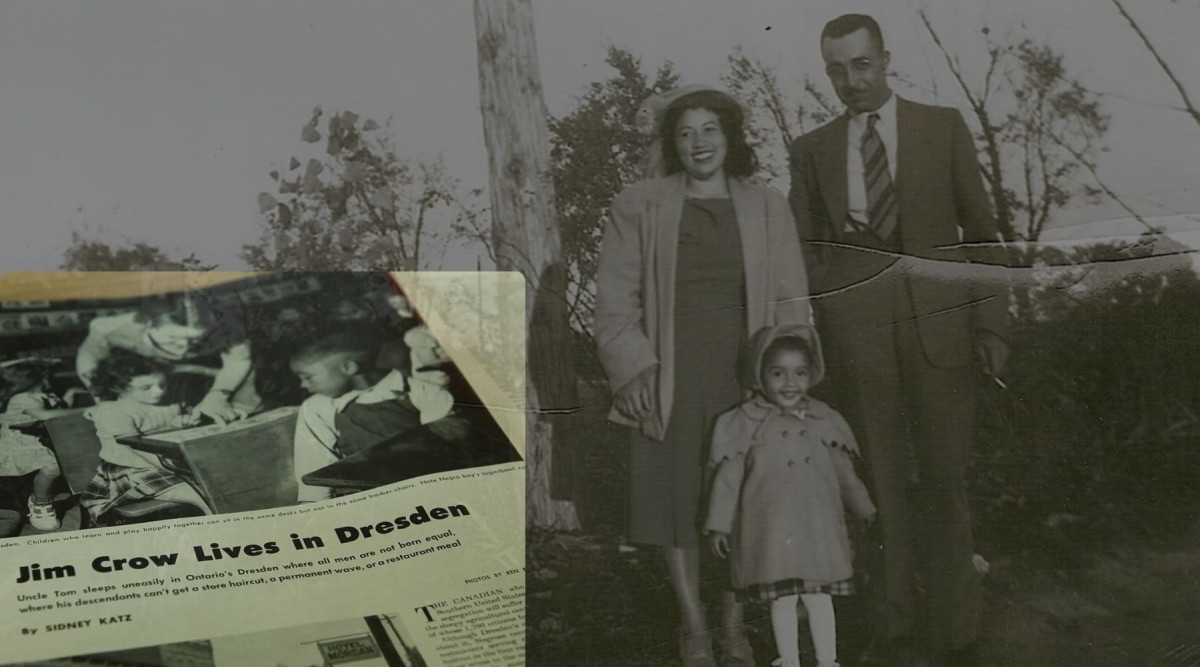
Sid Blum, executive secretary of the Toronto Labour Committee for Human Rights, brought journalists and photographers. Reports of Dresden's defiance spread across front pages. A feature in Maclean's Magazine titled "Jim Crow Lives In Dresden" caused a stir. CBC invited Burnett to appear on the radio and television. The National Film Board produced a documentary, "The Dresden Story," in the fall of 1954.
The publicity enraged Dresden's white majority. Anonymous letters threatened Burnett's life. Someone tried to burn down his house while his family slept inside.
Burnett got a gun for self-defence. That fact generated more headlines.
Opponents tried to discredit him as a Communist agitator. Burnett turned it into a weapon: "You don't have to be a Communist to demand your rights." Then he added with characteristic wit that Communists had "not yet" penetrated the NUA.
Under intense pressure, Premier Frost ordered prosecutions. In January 1955, a local magistrate found two restaurant owners guilty and fined them $50 each.
They appealed. Judge H.E. Grosch overturned the conviction in August, ruling that the complainants hadn’t been expressly "denied" service, and even if they had, the prosecution failed to prove it was because of "race or colour."
The first test of Canada's groundbreaking civil rights law had failed.
Creating a new civil right
The NUA ran more tests. Gathered more evidence. Filed more complaints.
In May 1956, Judge Harold Lang heard the appeal of another conviction. The defence argued the Fair Accommodation Practices Act was unconstitutional, criminal law beyond provincial jurisdiction.
Judge Lang examined the evidence that Burnett and the NUA had meticulously compiled. He upheld the conviction. Then he wrote something that would echo through Canadian legal history.
The Fair Accommodation Practices Act had not created "a new crie," he declared.
It had "created a new civil right."
For the first time in Canada, racial equality was a civil right. Racial discrimination was illegal.
In November 1956, an NUA delegation was quietly served in Dresden restaurants that had excluded them for years.
Hugh Burnett wasn't there to celebrate.
A boycott had been organized against his carpentry business. Without customers, he couldn't pay his employees. He resigned from his position as NUA secretary in March 1956 and left Dresden to seek employment in London, Ontario.
He won the war. But he lost his livelihood.
The perfect Canadian hero: Unrewarded and unsung
Hugh Burnett died on September 28, 1991. The National Unity Association held its last regular meeting in April 1958.
For decades, his story disappeared from public memory.
"It's less about being polite and more about reflection of the fact that there were so few African Canadians," explains Professor Dummitt. "So, it was easy for Canadians not to have to face the reality of discrimination in their midst. Burnett and the NUA and their allies brought this discrimination into the open."
Canada's self-image depends on not knowing this story. We prefer the narrative where racism is American, where we were always the good guys, where the Underground Railroad's final station represents the end of the story rather than the beginning of another struggle.
But historian James Walker, who researched Burnett extensively and wrote the Ontario Heritage Trust plaque dedicated to him in 2010, argues that Burnett's achievement was revolutionary. Traditional Anglo-Canadian rights, freedom of association, and freedom of commerce, had been interpreted to permit discrimination. The NUA "inspired recognition of freedom from discrimination as a fundamental principle," Walker wrote. "This led to a revolutionary change to the course of Canadian law and Canadian history."
The rights Burnett fought for are now enshrined in the Canadian Charter of Rights and Freedoms. We just forgot who put them there.
Making history visible again
This February, Burnett's story will reach a new generation through "Well, That Didn't Suck" (WTDS), a Canadian history series that refuses to let great stories stay buried.
Created by Trent University and the Canadian Institute for Historical Education, WTDS treats Canadian history as it deserves: compelling, relevant, and worth knowing. The Burnett episode — their fifth — focuses on the postwar campaign against segregation in small-town Dresden, including the sit-ins, legal challenges, violent backlash, and court victories that made discrimination illegal.
{https://www.youtube.com/watch?v=rtLfjEk_X6Q}
"Our focus is on telling great stories about fascinating Canadians," says Professor Dummitt, who works with the series. "American stories and American culture dominate how we think — what we think of as our history. This isn't true. Canada has its own unique history and heroes. We need to celebrate them."
The series makes Burnett's story accessible without diminishing its weight. It's a corrective to decades of erasure, a reminder that Black Canadians didn't wait for Americans to lead the way on civil rights. They were innovators, strategists, and winners of battles that rewrote the law.
"Burnett's story is pretty fascinating," Dummitt notes. "But it also matters because it shows how he was able to convince the Premier to change the law. It shows an openness to redefine our idea of what ought to be a right, and this was done not by the courts but in parliament. A decade before the American Civil Rights Act, and three decades before the Charter, Black Canadians convinced the Ontario government that discrimination was wrong. It's a heck of an achievement."