 By
On June 11 of this year, Prime Minister Mark Carney launched Canada's National Food Security Strategy. The federal plan earmarks $3 billion over ten years to increase the amount of food the nation produces, reduce dependence on global food processors, and make food more affordable for people.
Bronwyn Goodman, a spokesperson for Agriculture & Agri-Food Canada, spoke about the need for the strategy now. “These measures in the strategy are intended to improve food affordability by addressing costs across the food system. It is not about a single initiative, but the combined impact of actions across production, processing, distribution, infrastructure, competition, and supply chains.”
These measures come at a time of increased food insecurity across the nation. PROOF's April 2026 release put 24% of people in Canada in food-insecure households in 2025. Among Black people, the figure was 41.3%, the highest rate of any group in the country. Concentrated in big, expensive cities and making lower-than-average wages, Black folk often do not have the income to afford healthy food. Whether Carney's strategy moves that number is the question it has to answer. On the evidence so far, not much, and not soon.
What Makes Canada Food Insecure
Canada is the second-largest country on earth and grows a great deal of food. It still doesn't grow or process enough of the right kind.
Canada has slipped from the world's fifth-largest agri-food exporter in 2000 to seventh today, and sits eleventh for exports of manufactured food. Areas in southern Ontario, the Prairies, and Quebec are famous for their production of crops and food inputs like strawberries, grains, potash, and maple syrup, but Canada lags behind many of its peers in food processing. Processing food is what takes a bean plant from its raw form into tins, cans, and bags we pick up on the store shelves. “Processing is the more obvious missed opportunity. Canada is a major agricultural exporter, yet some of what we grow or raise leaves the country for processing while we import finished food,” said Sylvain Charlebois, Professor and Director at the Dalhousie Agri-Food Analytics Lab, one of the foremost experts on Canada's food system.
While countries like the US and France have food processing industries much larger than their primary agriculture industries, Canada's is only ten percent larger, according to the federal document detailing the National Food Security Strategy. Without larger manufacturing capacity, we export our grains and fruits to the United States and buy the finished product back. The document also highlights the staggering dependence we have on US processing capacity. Almost half of all our preserved fruits and vegetables come from the US. Trump's tariffs made that worse, and Canada's Food Price Report 2026 forecast another four to six percent on food prices this year. High food prices were a Canadian problem before Trump. “Geography, long transport distances, a short growing season, dependence on imported produce, and costs throughout processing and distribution all matter,” said Charlebois. “Limited competition in some parts of the supply chain can make those pressures harder to absorb.”
High prices are also a domestic supply problem. Every stage of the food industry in Canada's economy is made up of a handful of megaconglomerates. The top 5 grocery retailers, Loblaw, Metro, Empire (Sobeys), Walmart, and Costco, account for roughly 75% of sales, according to the Competition Bureau. Two firms, Cargill and JBS Canada, control approximately 85-90% of federally inspected beef slaughter in Canada. These few companies have overall control over prices and are part of the reason an agriculturally productive land like Canada can pay such high prices.
Geography, processing and competition are the three problems. The government’s strategy goes after the last two.
It aims to increase Competition Bureau investigations by ten percent through a $12.9 million annual budget increase, roughly $130 million in total, and expects that enforcement to save Canadians close to $350 million a year. The goal would be to catch practices that unfairly increase prices for consumers or underpay farmers for their produce. After Canada's massive bread scandal, anti-oligopoly practices are welcomed.
To expand processing at home, the government has earmarked $150 million for a Food Security Fund under the existing Regional Tariff Response Initiative, which it says will help food-related small and medium-sized enterprises “expand domestic processing capacity, food production, storage, distribution and delivery to communities.”
On when any of this shows up at the till, the government has no answer.
“Specific projections on food prices and the impact of the NFSS are not available as there are many different factors that can drive up consumer food prices,” said Goodman. Legal cases against conglomerates, increased food manufacturing, and the other policy plans in the strategy are all long-term changes. None of it feeds anyone this month.
“I would not expect this strategy to change prices materially in the next few months,” Charlebois. “Facilities take time to finance and build, and global prices, fuel costs and exchange rates will continue to affect what Canadians pay.” Even if the plan is fully implemented, he believes it is more likely to slow price growth than reverse it.
In the short term, the Feds are making the National School Food Program permanent, rolling out the Canada Groceries and Essentials benefit, and funding food banks through a new Community Support Stream. Food banks recorded 2.17 million visits in March 2025 alone, according to Food Banks Canada.
A good strategy would also look at the institutions already feeding Black communities and invest in them, so those communities gain control over their own food system instead of cheaper access to someone else's.
Food sovereignty is the right of people and communities to define their own food, land, and agriculture systems instead of leaving them up to global markets and large corporations. The term was coined in 1996 by La Vía Campesina, a global farmer movement led by Indigenous groups, migrant workers and small-scale farmers, to shift focus from simply having enough food to who controls how that food is grown and distributed. Since the arrival of Black communities to North America, we have been instrumental in food production, but rarely have had the opportunity to define our food, land and agriculture. Yet today there are several different Black-run farms that are changing that story. Like the Harvest Collective.
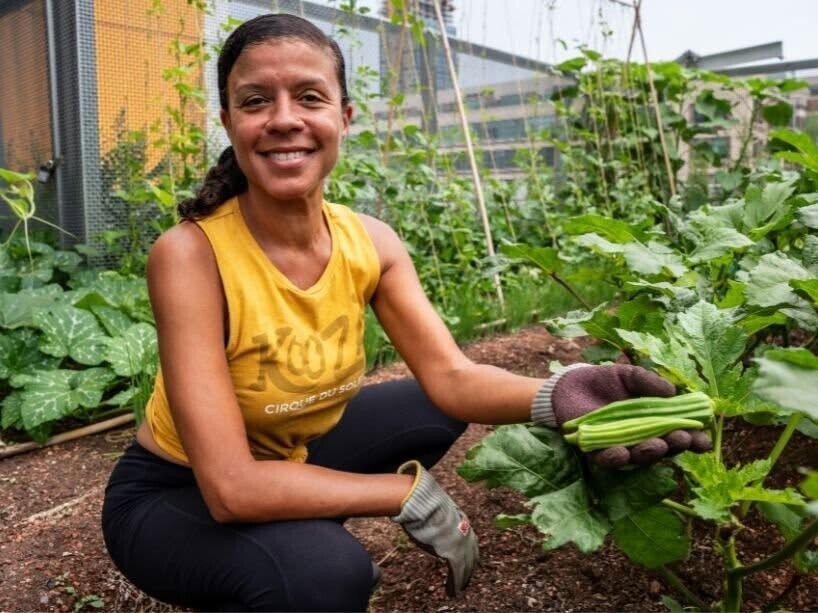
Nicole Austin, founder of The Harvest Collective, has been building that kind of control on a rooftop in downtown Toronto. She graduated as a dietitian from Toronto Metropolitan University in the middle of the pandemic, then took a job there as Program Coordinator in the Urban Farms program. She went on to build the school's first Black-centred food program, the Black Food Sovereignty Initiative (BFSI), on a retrofitted quarter-acre market garden at TMU's George Vari Engineering and Computing Centre. The Harvest Collective, the name of the TMU project, is one of dozens of Black-run farms in the city and across the country.
“When I talk about food with the community, they light up,” Austin said.
The goal of the BFSI was to grow Black food by Black people. By growing food that's Indigenous to Black cultures, the BFSI brings the diaspora together to celebrate crops that survived migration, dislocation, and Canadian winters: callaloo, okra, African eggplant, Scotch bonnets, mustard greens. Many of the seeds planted here have travelled the trans-Atlantic route to the urban farm. All in all, the farm has planted thirty-one different crops.
“My favourite crops change every season,” said Austin. “This time around, it is white velvet okra, heirloom okra, made over generations.”
The program runs on two arms. The Harvest Collective is the farming cooperative that gives away and sells produce, while the Learning Circle brings Black community members together to learn about the rooftop farm and ideas around food justice. Part of Nicole’s work involves talking with community members who want to grow food. “There was a Nigerian woman at one of our conferences. She just arrived in Canada and in two years was able to get land from Ontario Farmland Trust,” said Austin. She was given a 16.5-acre farm in Tiverton.
Since 2020, Harvest Collective's mission has fed students, the unhoused, and hundreds of others, and won Austin TMU's 2026 Viola Desmond Staff Award. Running a farm that grows tropical produce in Canada is not cheap or easy. Doing it chemical-free, distributing it for free, while teaching others to do it is nearly impossible. The collective runs on a model of threes: it donates one-third of its produce, sells another third at fair retail prices, and gives the last third to TMU students, or anyone in the area, at a discount. Paid tours and operational support from TMU keep it alive.
According to the Feds, the initiatives under the strategy are expected to benefit a wide range of food system actors, including community-based and not-for-profit organizations. The strategy plans to increase the number of food hubs, terminals, and cold storage facilities across the country to help independent grocers with the cost of food storage and distribution. Austin says the farm welcomes all forms of institutional support, while acknowledging that these are the same institutions responsible for anti-Black racism in Canada. “Many of the elders in the community were against working with racist institutions, but we can leverage this time of reckoning to use our voices to use these resources to uplift our community.” While TMU is heavily involved as a funder and home for the Harvest Collective, other more independent farmers require more support.
In an open letter to the City of Toronto in early 2025, Jessey Njau, the operator of Zawadi Farms, called for an increase in distribution and storage capacities for independent and cooperative farms. Njau, who operates a cooperative farm in Toronto's Downsview Park, believes the Fed's strategy can help small growers if they can access new terminals to store food, but he notes the policies need to target small grocers like his. “They can help us if small growers are at the table when they're designed. The funds mainly target independent grocers that currently depend on big chains for distribution. That matters to a farm like ours, because more independent buyers means more places to sell.”
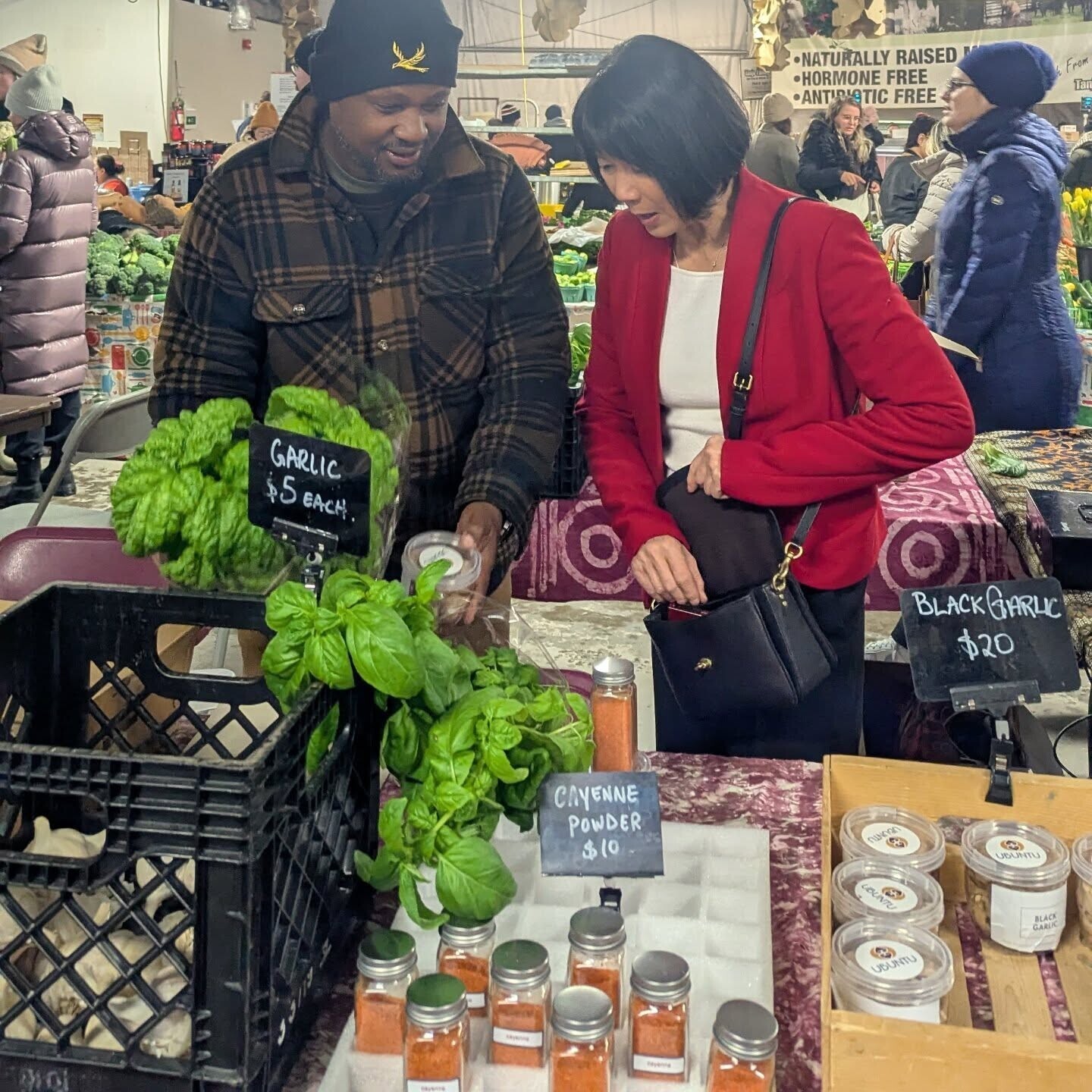
Zawadi feeds hundreds across Canada's biggest city, including people in its shelter system. Njau wants multi-year grant funding instead of the one-year cycle, open procurement so schools and hospitals can buy local, and proper labelling. Without that support, farms like Zawadi are pushed into side ventures such as education programs. Those create support for the farms, but do not replace government intervention.
Back at the farm, the Learning Circle brings Black community members, students, and allies together to share what they know. Moringa is one example, a therapeutic found in tea and hair products that has always been transnational, growing across Africa, the Caribbean and the tropics. Austin says it is also what brings Black teens to her. “One student from Senegal came to the farm and brought Moringa seeds from back home. That was a treat.”
So while every part of the Fed's food security strategy may not impact Black communities, there are still people like Austin working to make food more affordable and culturally relevant for the Black community, and all communities. If everything works out, this strategy could have positive impacts years from now. But its long-term focus on supply and competition means Canadians shouldn't expect prices to drop anytime soon.
Until then, a sizable part of the Black community is left to deal with high food prices on low incomes. Buying from small growers connected to the Black community can help everyone. Buying from Black farms, nonprofit or otherwise, is how we secure Black sovereignty.