 By
Why aren’t we ever building our own?
You will hear those who argue, “But the Black experience is different!”
So too was the persecution of Sikh truckers in 1980s Surrey, the exclusion of Chinese Canadians under the Head Tax, and the internment of Japanese entrepreneurs during WWII. Yet these groups forged parallel economies through communal savings, trust networks, and vertical integration.
The core problem facing Black entrepreneurship in Canada is not the uniqueness of our struggle but structural dependency on externally designed systems—funding models, success benchmarks, leadership paradigms—that infantilize and outsource ambition while eroding the self-determined strategies our ancestors deployed under far harsher conditions.
If 1900s Black Durham could birth a self-contained economy under Jim Crow, or Maggie Lena Walker’s bank turn laundresses’ nickels into mortgages, what justifies 21st-century complacency? A victimization-dependent culture has supplanted the universal laws of economic power: build your own table, or forever negotiate for crumbs at someone else’s.
The Trust Deficit: A Structural Barrier to Capital Sovereignty
Black entrepreneurship’s reliance on externally designed systems is rooted in a profound trust deficit within the community itself—a gap other immigrant communities have historically bridged through informal, trust-based capital networks.
For example, Vietnamese entrepreneurs in Montréal leverage diaspora networks for zero-interest loans. These systems thrive on shared cultural understanding, reciprocal accountability, and intergenerational trust.
The fundamentals of self-reliance and entrepreneurial-based wealth building are not something unfamiliar to people of African descent. From the Caribbean’s sou-sou or Jamaica’s pardna, rotating savings clubs and informal credit circles derive from the West African Yoruba word esusu, a traditional, community-based savings system where a trusted group of people pool fixed amounts of resources and money, and take turns receiving the lump sum. These are universal first principles, often found in cultures and societies, and Black cultures are a part of these universal first principles of community savings for economic advancement.
The Dynamics of Trust: Culture, Power, and Institutional Capture
Trust is not merely a social virtue but an economic infrastructure. Immigrant communities deploy trust as a governance tool: reputation systems deter defaulters in savings circles, kinship ties ensure collective risk-sharing, and cultural alignment streamlines decision-making.
Jewish immigrant communities in Canada in the early twentieth century arrived with limited resources and with centuries of trauma from persecution, discrimination, and genocide. Concentrated in Montreal and Toronto, they settled in garment manufacturing, scrap metal, real estate and small retail enterprises, and grew from there. They relied on landsmanschaft, informal credit associations that functioned as community-controlled capital pools: rotating savings, mutual guarantee systems, and the reinvestment of retained earnings into family and community ventures.
Many Black Canadians today, however, look externally first, instead of internally, to institutional “solutions” like government grants or corporate DEI ‘partnerships’ that often demand that entrepreneurs prove their worth through misaligned metrics—business plans vetted by non-Black panels, scalability models divorced from community needs—diverting energy from nurturing internal trust networks.
Epistemic displacement occurs without communal trust; entrepreneurs internalize the myth that their ideas lack value until validated by outsiders—the White supremacy culture and system, which we put more trust in than ourselves and our own community. The paradox: even critiques of oppressive systems remain framed by those systems’ logic, as trust’s absence leaves no foundation for alternative frameworks.
Implications: Trust as the Threshold of Collective Power
The inability to cultivate trust imperils all aspirations for socioeconomic self-determination. Without it, Black entrepreneurs cannot marshal the collective risk-taking, resource-sharing, or decentralized governance required to build sovereign capital ecosystems.
Other immigrant communities exemplify this: a Korean Canadian grocer in Vancouver can secure a loan within hours through a kye network because trust binds lenders to borrowers through familial reputation and shared stakes. Conversely, Black entrepreneurs pitching ventures to their own communities often face skepticism amplified by trauma and mental slavery—distrust of “another scam” or fear of supporting “risky” Black-led ideas, and the community ridicule often faced if failure occurs—not conducive to entrepreneurial growth, and based in the legacies of the plantation and colonial systems, and serves in present times to fracture potential capital pools into scattered, underfunded efforts of distrust.
Nevertheless, trust remains the difference between transactional survival and transformational power. Without trust, Black Canadians remain locked in a reactive stance—critiquing exclusionary systems while relying on them—rather than mobilizing the collective capital, knowledge, and agency that trust unlocks.
Until trust is understood as a first principle and rebuilt as an actionable, intergenerational currency, systemic dependency will persist, and entrepreneurship will remain a solo struggle, not a communal engine of growth and self-determination.
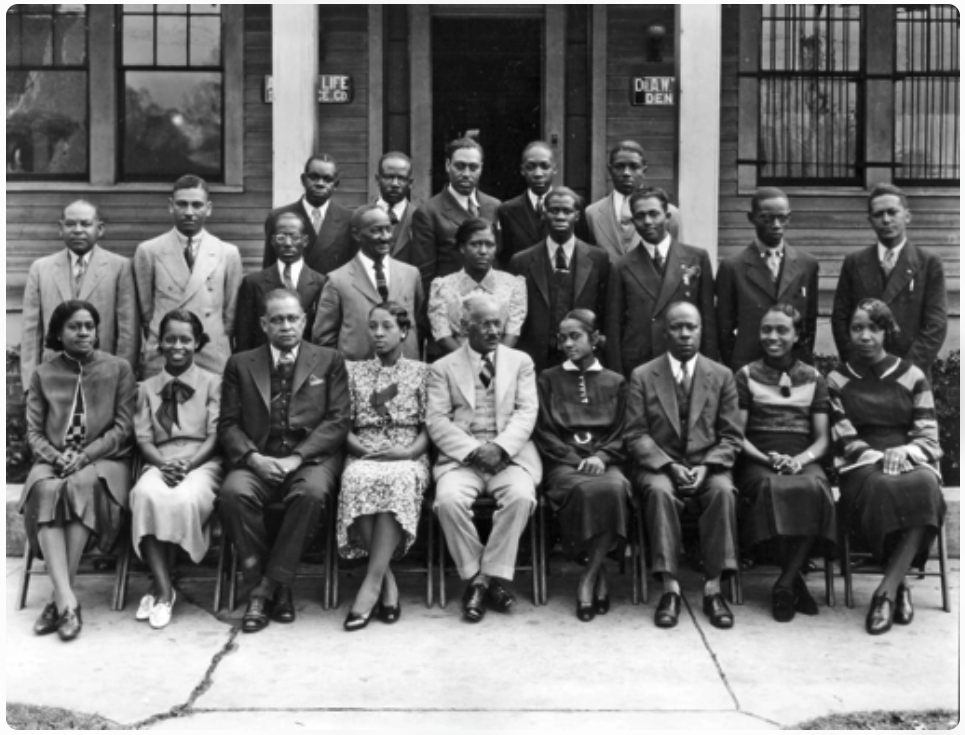 Officers and directors of Atlanta Life Insurance Company in 1923. Source: The History of Black Business in America: Capitalism, Race, Entrepreneurship By Juliet E. K. Walker, first published in 1998.
Historical Precedents: The Architecture of Kinship Capital
Vancouver’s early Chinese Canadian entrepreneurs transformed humble laundries into real estate empires using Hoy Ping rotating credit societies—informal banks rooted in communal accountability.
They understood a universal first principle truth: capital compoundment begins with sovereignty over its flow.
By insulating their ecosystems from external interference, they absorbed risks, retained profits, and aligned investments with cultural priorities. Crucially, they rejected the notion that legitimacy required institutional approval; their trust networks were the institution.
When Sikh immigrants in 1980s Surrey faced violent racism—graffiti, exclusion from unions, wage theft—they bypassed appeals to government and forged their own path. Pooling savings to buy trucks, then logistics firms, then industrial land, they weaponized collective trust into vertical integration. This wasn’t charity; it was strategic interdependence: a driver needing repairs tapped a community mechanic, who sourced parts from a Sikh-owned supplier, who financed inventory through temple-based microloans.
Within decades, this trust-network scaffolding transformed marginalized labourers into pillars of British Columbia’s transportation and lumber sectors. Their success underscores a stark contrast with modern dependency paradigms: they viewed systemic barriers not as excuses but as problems to outflank through self-funded coordination.
The Cortellucci family’s $40 million anchor donation to Vaughan’s hospital epitomizes intergenerational wealth in action. By mobilizing their construction empire’s network—relatives, paisans, allied business owners—they didn’t seek permission to lead; they set terms. Their model, replicated by Italian Canadian circoli di Risparmio (savings circles) that bankrolled Ontario’s Italian construction dynasties, illustrates how trust amplifies capital.
Governments and corporations flock to fund projects already validated by cohesive, self-reliant communities. Herein lies the lesson: wealth begets influence when deployed internally first. Nonprofits reliant on grants, by contrast, operate in a contradiction—seeking profit through structures designed to stifle it, often funnelling resources into administrative bloat rather than scalable ventures.
The Cortelluccis’ legacy wasn’t built on grant applications but on a simple formula: control capital, command respect, compel collaboration.
Connective Thread: These groups thrived by treating trust as operational infrastructure, not abstract idealism. Their models shared three traits: (1) capital circulation insulated from external agendas, (2) loss absorption as a communal responsibility, and (3) reinvestment disciplined by long-term cultural vision. For Black Canadians, the imperative is clear: power flows not from critiquing exclusion but from mimicking these architectures of insular prosperity—replacing grant-dependent intermediation with self-funded, trust-anchored ecosystems.
The Golden Age of Black Business: A Testament to Self-Reliant DNA
The early 20th century’s “Golden Age of Black Business” stands as irrefutable proof that self-reliance is encoded in Black economic DNA. Faced with Jim Crow’s brutal exclusion, Black Americans built 40,000+ enterprises—banks, insurers, hospitals—without grants, DEI initiatives, or paternalistic mentorship programs.
In Tulsa’s Greenwood District, Black Wall Street thrived as a parallel economy where the Black dollar circulated dozens of times before exiting the community, funding everything from newspapers to hospitals. North Carolina Mutual Life Insurance didn’t lobby for white approval; it pooled premiums from church basements to become America’s largest Black-owned business, reinvesting profits into Black entrepreneurs. Maggie Lena Walker’s St. Luke Penny Savings Bank transformed nickels from domestics into mortgages for Black homeowners, bypassing racist lenders.
These weren’t acts of desperation but masterclasses in collective agency: segregation’s constraints forced Black America to internalize capital, talent, and ambition, creating self-contained economies that turned exclusion into advantage.
The lesson: Scarcity, met with discipline, births sovereignty.
W.E.B. Du Bois and Booker T. Washington, despite ideological clashes, agreed on a core truth: economic self-determination precedes political or social equity.
Du Bois’ studies on Black Durham documented cooperatives and mutual aid networks that fortified community wealth. Washington’s Atlanta Compromise urged Black Americans to “cast down buckets” where they stood—building vocational skills, farms, and enterprises to make themselves indispensable.
Their philosophies diverged in tactics but converged in strategy: internal economies create external power. The National Negro Business League, founded by Washington, didn’t petition for inclusion; it forged commercial alliances among Black entrepreneurs, vertically integrating supply chains from farms to grocery stores.
This wasn’t resignation to racism but cold-eyed pragmatism: they understood that the universe rewards ownership, not grievance. As Du Bois wrote, “The power of the Negro of today is… his economic position”—a position carved not through appeals to morality but through unrelenting productivity.
Past leaders treated segregation as a problem to outmaneuver; today’s rhetoric often treats systemic barriers as insurmountable, fueling a victimhood industrial complex. But the universe’s laws haven’t changed: it grades solely on what you have built.
Our ancestors grasped this, bending cosmic indifference into Black hospitals, insurers, and land trusts. To honour their legacy, we must reject the lie that historical trauma entitles us to dispensations. Scars are not excuses—they’re proof of survival, and survival demands we reclaim the sophistication of self-preservation they mastered: control capital, compound gains, never outsource your destiny.
To those who claim “the Black experience is incomparable”: The difference isn’t in the suffering, but in strategy. Our ancestors built 40,000 enterprises under actual apartheid—no microloans, no hashtags, just discipline and pooled pennies. If Greenwood’s entrepreneurs could turn redlined ghettos into self-contained economies while dodging lynch mobs, what possible barrier justifies our inertia today? Systemic racism is real, but so is the $1.6 trillion Black consumer market—a resource our grandparents leveraged without access to.
The “unique trauma” argument, weaponized as a shield against accountability, dishonours Maggie Lena Walker’s ledger books and Booker T. Washington’s bootstraps. Other marginalized groups built power through action, not exoneration through pain.
If we insist our wounds are too singular to heal, we surrender agency to the very systems we claim oppress us. The Golden Age didn’t wait for reparations—it wrote its own. Either we inherit that defiant pragmatism, or we concede that 21st-century Black Canadians lack the ingenuity of their Jim Crow-era ancestors. Which legacy will we claim?
Black entrepreneurship’s future hinges on a radical return to its roots: rejecting the fiction that equity can be begged from systems engineered to deny it. The paternalistic trap of modern “Black Entrepreneurial Programs” is not merely misguided—it is a betrayal of the unyielding self-determination that birthed Black Wall Street and the Golden Age of Black Business. These programs, with their performative benchmarks and dependency-inducing grants, are neocolonialism repackaged as progress. They demand obedience to rules rigged against us, trading sovereignty for scraps of validation.
Maggie Lena Walker didn’t petition white banks for fair loans—she created her own, turning laundresses’ coins into generational mortgages. North Carolina Mutual didn’t lobby for inclusion—it rewrote the actuarial tables, proving Black lives were insurable. Their playbook remains clear: internal capital + communal trust = unconquerable agency.
Token board seats, DEI-driven grants, and government-funded nonprofits are distractions if not a setup—gilded cages that swap ownership for applause. True power lies not in occupying someone else’s table but in forging our own steel: Black-owned venture funds that finance Black tech disruptors, rotating credit societies that bypass exclusionary banks, and mutual aid networks that turn $100 monthly contributions into $1 million seed rounds.
The universe’s laws remain immutable: rewarding those who build, never those who beg.
Our ancestors, stripped of everything, built parallel economies. Today, with far greater resources, we have no excuse to outsource our ambition. And to those brokering trauma for grant money or mistaking corporate photo-ops for progress, heed this: history will remember you as collaborators in our stagnation.
The path forward is etched in the ledgers of Black mutual insurers and the rubble of Tulsa’s burned-out banks—wealth flows where trust is weaponized, capital is sovereign, and liberation is nonnegotiable. The choice is binary: reclaim our legacy as builders or fade into irrelevance, tenants in a world that rewards only owners.